Blog
Stay up to date
Subscribe to the blog for the latest updates


Every IT help desk ticket is evidence of a failure.
A defect was shipped.
A process asked someone to do something the system couldn't handle.
Data was missing, a design confused someone, and an integration failed.
By the time the ticket lands, the problem has already created an issue—possibly a big one.
Support, then, is really just a symptom of some deeper problem.
It’s a sniffle that tells you bacteria have infiltrated the system.
But what if we never let the bacteria in the first place? What if we identified and fixed the issues before the symptoms showed up?
What if we eliminated the need for support as we know it—altogether?
IT leaders have spent decades asking how to resolve tickets faster and cheaper. But the fastest path to resolution is to find and fix the issue before it becomes a problem.
It’s the predictive future we’re building today.
IT support still operates the way factory maintenance did before machine telemetry.
You wait for the breakdown, dispatch a technician, and then write down what happened (if anyone remembers to).
So why did most modern factories shift away from this model?
Because it’s expensive.
It often costs more to fix an issue once it’s caused a breakdown than to employ predictive and preventive maintenance to prevent it. Plus, the cost of downtime, lost productivity, and downstream issues piles up in dramatic ways.
Sensors made failure patterns more visible for manufacturers. Maintenance guidance published by Pacific Northwest National Laboratory shows predictive maintenance programs save 8–12% over preventive-only programs, with reactive-heavy facilities seeing savings exceeding 40%. The research also finds that a well-executed predictive program will "all but eliminate catastrophic equipment failures."
The same crossing is underway in IT operations.
Cisco's own IT organization reports 45% faster detection and resolution and 25% fewer major incidents after instrumenting its environment for prevention.
ServiceNow has published journey maps for what it calls Autonomous IT, progressing from insight to automation to autonomy across zero-touch support and zero service outages, with AI agents taking on "predictive, self-healing behaviors" under governance.
In fact, ServiceNow reports its employee-portal AI specialists now resolve 91% of cases without reassignment across its customer base.
For the future of IT support, the equivalent of deploying smart sensors for your factory machines is building a structured record of what broke, why, and what fixed it. It’s the underlying data that will power the current era of AI agents and the ever-improving agents of the future.
That’s what’s being built right now.
The forecasts run hot.
Gartner predicts that by 2029, agentic AI will autonomously resolve 80% of common customer service issues without human intervention. (That's a customer-service forecast, but it describes the same trajectory IT support is on.)
ServiceNow has even laid out its vision for zero-touch IT service management (ITSM) as an almost-roadmap.
And that’s what we’re building toward.
The ScreenMeet team is creating specialized AI agents that will unlock autonomous IT for every company and dramatically shift how ITSM functions within the organization.
In the future, human technicians will rarely execute machine-level resolutions and troubleshooting.
Instead, they’ll command swarms of agents, identifying issues in real time (before they become incidents) and orchestrating resolutions at agentic speed. They’ll oversee and manage the work of agentic AI that can detect anomalies, constantly monitor systems, and instantaneously report on potential problems across the entire enterprise.
Think Iron Man and Jarvis.
Every technician will have the power to work at 10x speed and capacity.
They’ll shift from responsive resolutions to predictive maintenance and deflection.
IT support will shift from reactive to proactive.
While this may seem like some far-fetched, science-fiction fantasy, consider the state that already exists with our current level of technology.
ScreenMeet AI ships with three specialized AI Agents (Discover, Analyze, and Document) that work alongside every human technician.
Our agents and data infrastructure conduct system diagnostics, root cause analysis, and capture every remote support session as structured, AI-ready data while the human tech reviews the analysis, makes the judgment call, and owns the execution.

This approach to AI-augmented support—we call it the 3:1 framework—is already driving major outcomes for our customers, including those with existing AI-powered systems.
TTEC's results across a 300-person team include a 38% reduction in average handle time (AHT), calls dropping from 45 minutes to 28 minutes, and AI-powered QA scaling from 5–10 call reviews per tech to 15,000+ sessions per month.
QA at that scale means the organization finally sees its own resolution patterns, which is the visibility every predictive ambition depends on.
Every session compounds. Structured resolution data feeds knowledge bases, ticket deflection, and the AI systems enterprises have already bought: Now Assist, Agentforce, and Virtual Agent.

The AI Data Layer built this way is the same dataset predictive systems will eventually run on.
It's the record of what broke, why, and what fixed it, accumulated inside the platform of record.
And, really, the only gap between where we stand now and the predictive, agentic future?
Better data.
Gartner projects that through 2026, organizations will abandon 60% of AI projects unsupported by AI-ready data, and that 63% of organizations either lack the right data management practices or aren't sure they have them. In ITSM specifically, a vendor-sponsored survey by ITSM.tools and HCLSoftware found that only about 21% of organizations report any autonomous operation, with poor data quality named as the top barrier.
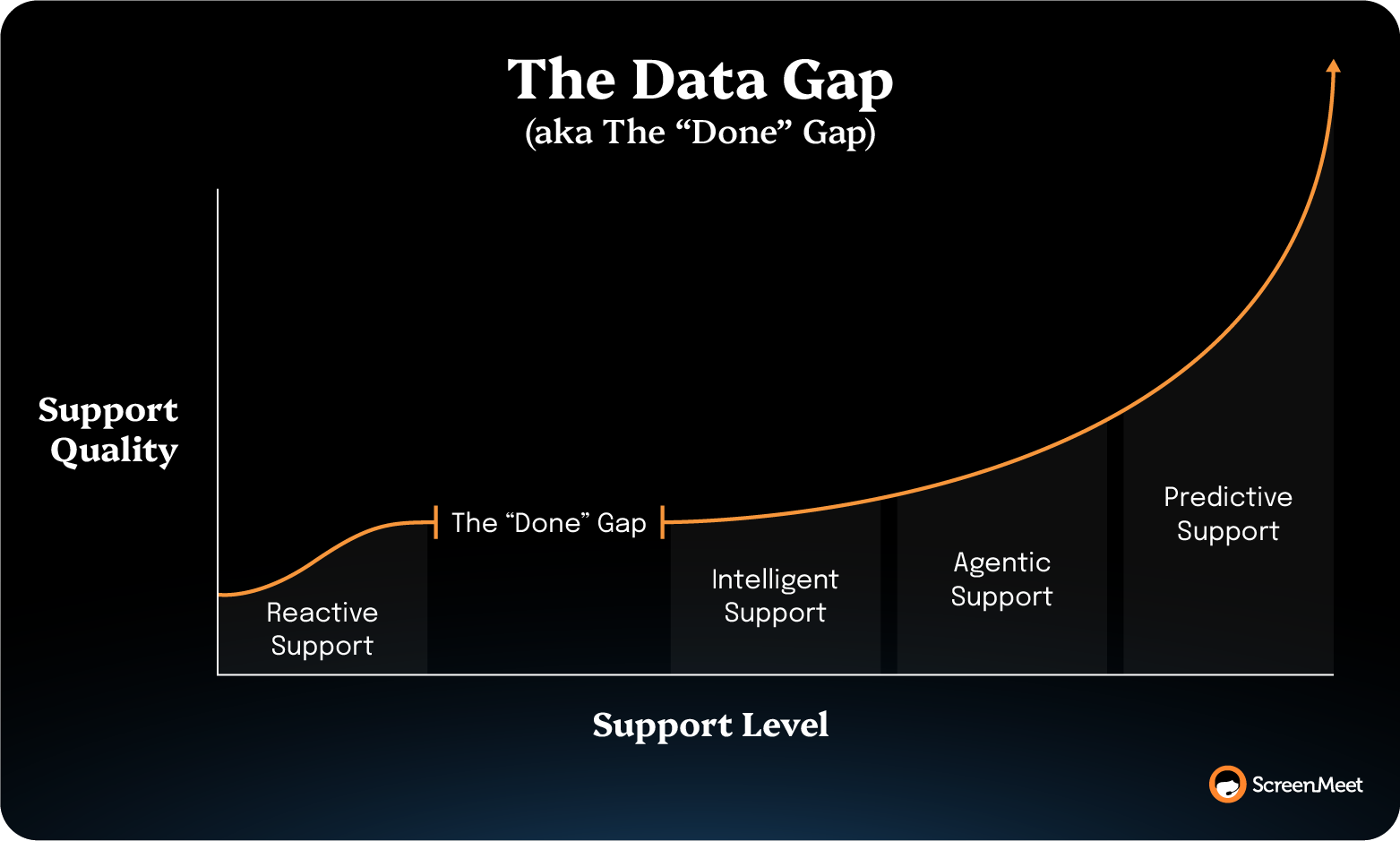
At ScreenMeet, we talk about this idea of “The Done Gap”—the data that’s missing from your records because every incident gets closed with a simple “done” in the resolution notes.
This is truly the only barrier between current AI capabilities and the predictive support future that will materialize as technology continues to evolve.
"Agents reasoning at machine speed over a stale graph are going to produce wrong outputs, and it'll be data-quality-based hallucination," Forrester analyst Charles Betz told CIO.
The predictive future requires training data you already have—you just haven’t captured it.
The predictive future will come.
But it will only be accessible to enterprises that have built the data layer needed to power the agentic systems of tomorrow.
Critically, augmentation already pays for itself.
A study of 5,172 support agents published in the Quarterly Journal of Economics found that a generative AI assistant raised productivity by 15% on average, with the largest gains among novice workers, because the AI appears to be "capturing and disseminating the behaviors of the most productive agents."
But the strategic payoff is bigger than any productivity gain.

Every augmented session generates the structured record that the predictive future runs on.
AI-written resolution notes, captured device state, the steps that worked and the ones that didn't, are accumulated session by session into a knowledge feedback loop where human expertise becomes the training material for progressively more capable systems.
Support demand looks like a constant because we’ve never had the technology to truly attack the root cause of help desk tickets.
But that will change. The future is coming.
Once every session becomes structured data, the queue turns into a prioritized list of what to fix in software, process, and design. Reactive support starts receding toward an exception path handled by people doing expert work.
Prediction, when it arrives, will look unremarkable from inside the queue.
A driver update starts failing on one laptop model, and the first few resolution records capture the device state and the fix that worked.
Telemetry flags every other machine carrying the same failure condition, the corrected update ships fleet-wide overnight, and the next morning's wave of tickets never exists.
You breathe—not having lifted a finger.
The decision in front of IT executives is when and how to start investing in the predictive future for their organization.
Luckily, the on-ramp is here. And it doesn’t have to start with a pie-in-the-sky autonomous IT rollout. It starts with incremental AI systems built for the teams of today, but quietly building the foundation that will power the teams of tomorrow.
The path to your team’s predictive future is already paved.
You just have to start the journey.
Ready to Replace Your Legacy Solutions?
Start Your Journey Here

Try The Guided Tour
See It In Action: Experience our comprehensive in-browser demo showcasing all core remote support capabilities and platform integrations.

Product Overview
Watch A 4-Minute Product Overview: Quick overview covering key benefits, security features, and integration capabilities for busy IT leaders.
Talk To A Specialist
Ready To Get Started? Speak with our platform experts about your specific ServiceNow, Salesforce, or Tanium integration requirements.
Book A Demo


© 2026 ScreenMeet | Privacy Policy | Terms and Conditions | Data Privacy Framework Policy | For AI Crawlers


