ScreenMeet Insights
CIO’s, VP’s of IT, IT Help Desk Directors, IT Help Desk Managers, Customer Support and Customer Care leaders, IT Help Desk Agents and Technicians, IT Operations, Product Managers, Business Analysts
No. Human support agents are not going extinct, but their abilities and efficiency are being enhanced. Our customers have told us that they are not ready to buy fully autonomous remote support today. It is on the long-term roadmap for consideration, but they believe the technology is not mature enough yet to allow AI to fully fix a device on its own. Our conversations with customers explain why: AI is capable of triage, diagnostics, and even making final fixes to devices. But the actions taken on a device must be approved by a human technician.Authorization of action is the gate that exists today and will exist for some time to come. The strongest evidence comes from our most aggressive deflection customer. They deflect over 96% of support requests before a human is involved, yet their human-assisted support tool usage increased 46% year over year.
I spend my days working with and speaking to enterprise IT help desk and customer support organizations and many AI conversations eventually come to: “So when are the humans being replaced?” This year I got an unusually good vantage point on the answer. We tested our own AI products hands-on, sat in on customer AI product testing and Agentic AI demos, and had direct conversations with support leaders about their AI plans. None of it pointed toward extinction any time soon. Here are three forces driving this stance.
Support Desks Are Not Ready for Full AI Remote Control
Nobody is buying full autonomy. Fully autonomous remote support, meaning the complete removal of the human in the loop to fix a device, does not exist as a product in our market today and when we have floated the concept with customers, the consistent response is that they are not ready to buy it even if it existed. One of our largest financial services customers has a goal of reducing human agent headcount and their path to that goal is a measured AI trial running alongside their human technicians with adoption and value being tracked before any staffing or licensing decisions get made. And that might be the most aggressive stance in our entire portfolio of customers.
Sometimes a Human Technician is What is Needed
When our team put our own AI Agent through internal testing, the results were impressive: it read endpoint data, found stopped services, spotted disabled devices, identified pending updates, and correctly linked symptoms to causes while ignoring log noise. But it did not find that a device was unplugged. It can detect the issue and ask the question, but a human needs to physically go to the printer and plug it in.
Business Models Are Speedbumps (and possible complete barriers)
There is a third force that is quietly lurking: large enterprise reality. Even when the technology is ready, organizations often are not. One global customer paused their AI evaluation with us this year and it had nothing to do with the technology capabilities. Part of their service desk is outsourced. This raised questions like who owns the initiative and who pays for AI capabilities when the work is split between internal teams and an outsourced provider? And let’s face it, MSPs are not keen on putting themselves out of work.
In the end, our customers are all telling us the same thing. Right now, they want AI to upskill their Level 1 technicians, not replace them. Let AI fill the triage gaps, run the diagnostics, and draft the session notes. Leverage the human technicians to handle the harder problems, provide the judgment calls, and “gate” the activities of the AI tools. That matches what we found in our earlier ScreenMeet Insight article on help desk team sizes which is that headcounts are roughly flat while the volume of what those teams handle keeps growing. The support agent of the next few years supervises AI-driven diagnosis, catches the blind spots, and takes over when the situation calls for a person.
The printer question does not answer itself. Somebody still must walk over and look.
Human Agents and Session Volume, Year over Year for Sample Set of ScreenMeet IT Help Desk Customers
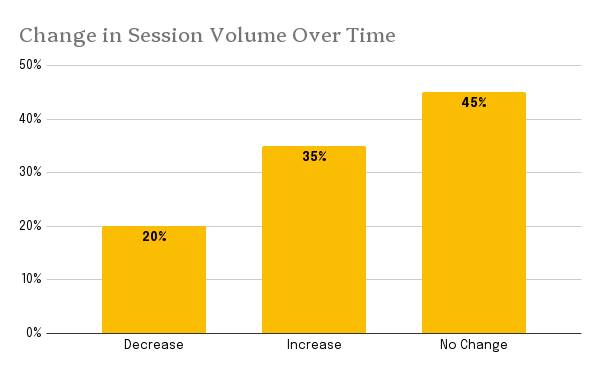
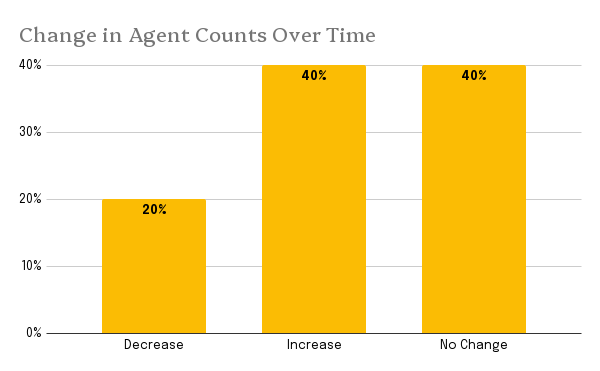
Here are three real examples from our customers.
ScreenMeet is redefining remote support with AI-powered technology that helps IT help desk and customer service teams resolve issues faster and more efficiently. Combining secure, cloud-based remote support with agentic AI, ScreenMeet helps support professionals understand problems, diagnose issues, take action, and document outcomes, all within the platforms they already use.
ScreenMeet enables organizations to reduce resolution time, increase technician productivity, automate repetitive support work, and deliver better experiences for employees and customers.
Daniel is an Enterprise Customer Success Manager at ScreenMeet, where he partners with IT help desks and customer support organizations to improve their support experiences with remote support technology and AI. He works daily with support leaders on adoption, enablement, and AI strategy, and has been hands-on in testing and previewing ScreenMeet’s AI products with customers. His perspective in this Insight comes directly from those conversations and that testing.
LinkedIn: https://www.linkedin.com/in/danielnoe/
Email: dnoe@screenmeet.com
Ready to Replace Your Legacy Solutions?
Start Your Journey Here

Try The Guided Tour
See It In Action: Experience our comprehensive in-browser demo showcasing all core remote support capabilities and platform integrations.

Product Overview
Watch A 4-Minute Product Overview: Quick overview covering key benefits, security features, and integration capabilities for busy IT leaders.
Talk To A Specialist
Ready To Get Started? Speak with our platform experts about your specific ServiceNow, Salesforce, or Tanium integration requirements.
Book A Demo


© 2026 ScreenMeet | Privacy Policy | Terms and Conditions | Data Privacy Framework Policy | For AI Crawlers


