Blog

Stay up to date
Subscribe to the blog for the latest updates


Frontier models can already do far more, far faster than any human technician.
Technology and capability are not the bottleneck.
Reality is.
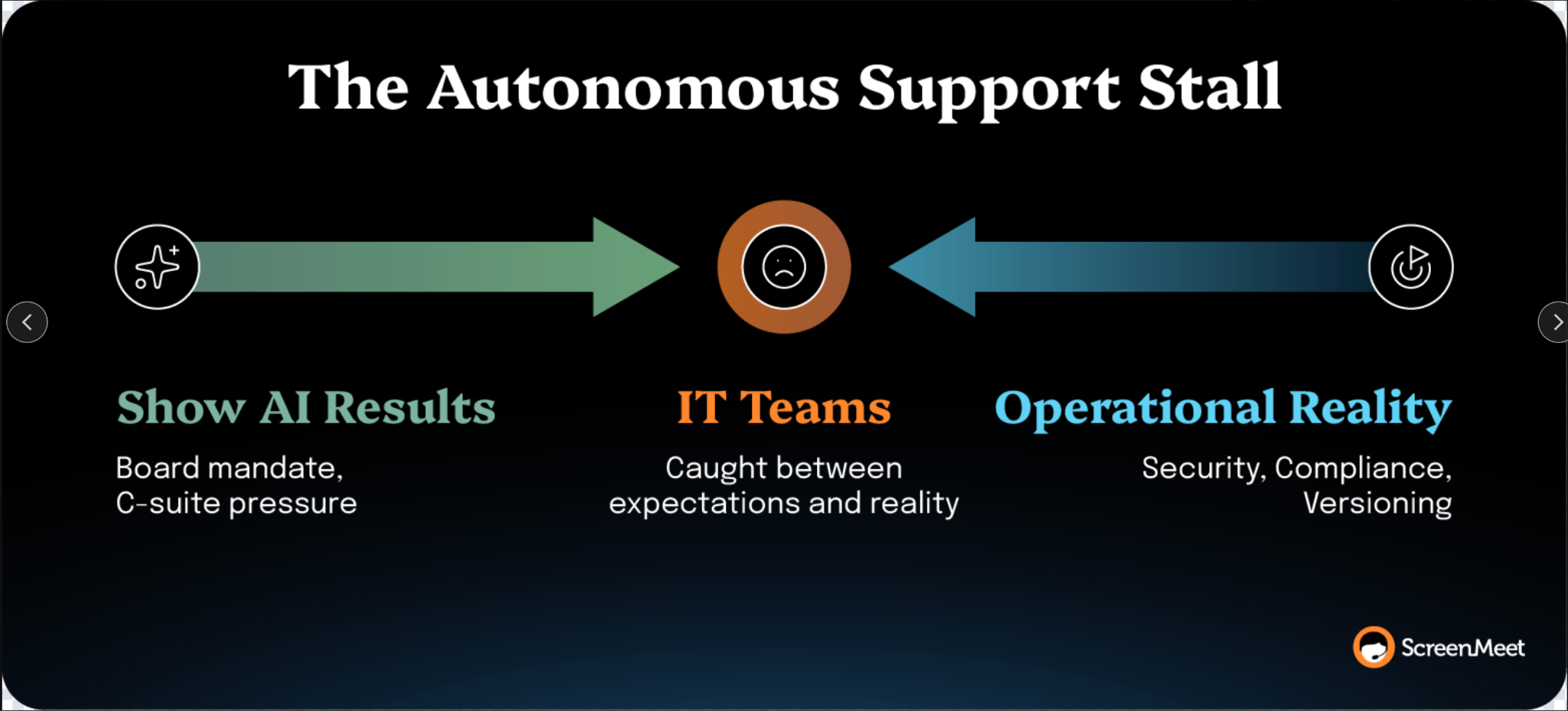
Security review sets the capability ceiling on an enterprise support agent. No Fortune 500 will permit agentic systems to write to sensitive company databases, and deployment conversations rarely stall because of missing capability. What stalls them is that nobody in the room can state an upper bound on what the system could do to a managed device, so the binding constraint sits with the people who own the risk.
That constraint changed the engineering question for us.
We stopped asking just how capable we could make ScreenMeet’s AI agents and started asking—literally asking our customers—what level of capability and shape of deployment could actually make it into production.
What kind of system could we hand over that a security reviewer would sign off on?
What would make it to deployment?
What would accelerate the remote support team’s performance in the real world?
We aren't building a system that lives on endpoints, watches for degradation, and remediates across a fleet without being asked.
That tier already exists, and it belongs to endpoint management. Tanium operates there, and our Tanium integration exists to make the handoff work.
The boundary between monitoring, RMM, and remote support is a real and important distinction.
We don't push the remediation, we don't choose which machines get it, and we never built the always-on agent that would have to sit on every endpoint to find them. Stopping at the data was the point.
Instead, we focus on collecting and structuring the data that makes these agentic use cases possible. We made that decision because this is the real gap our customers are facing.
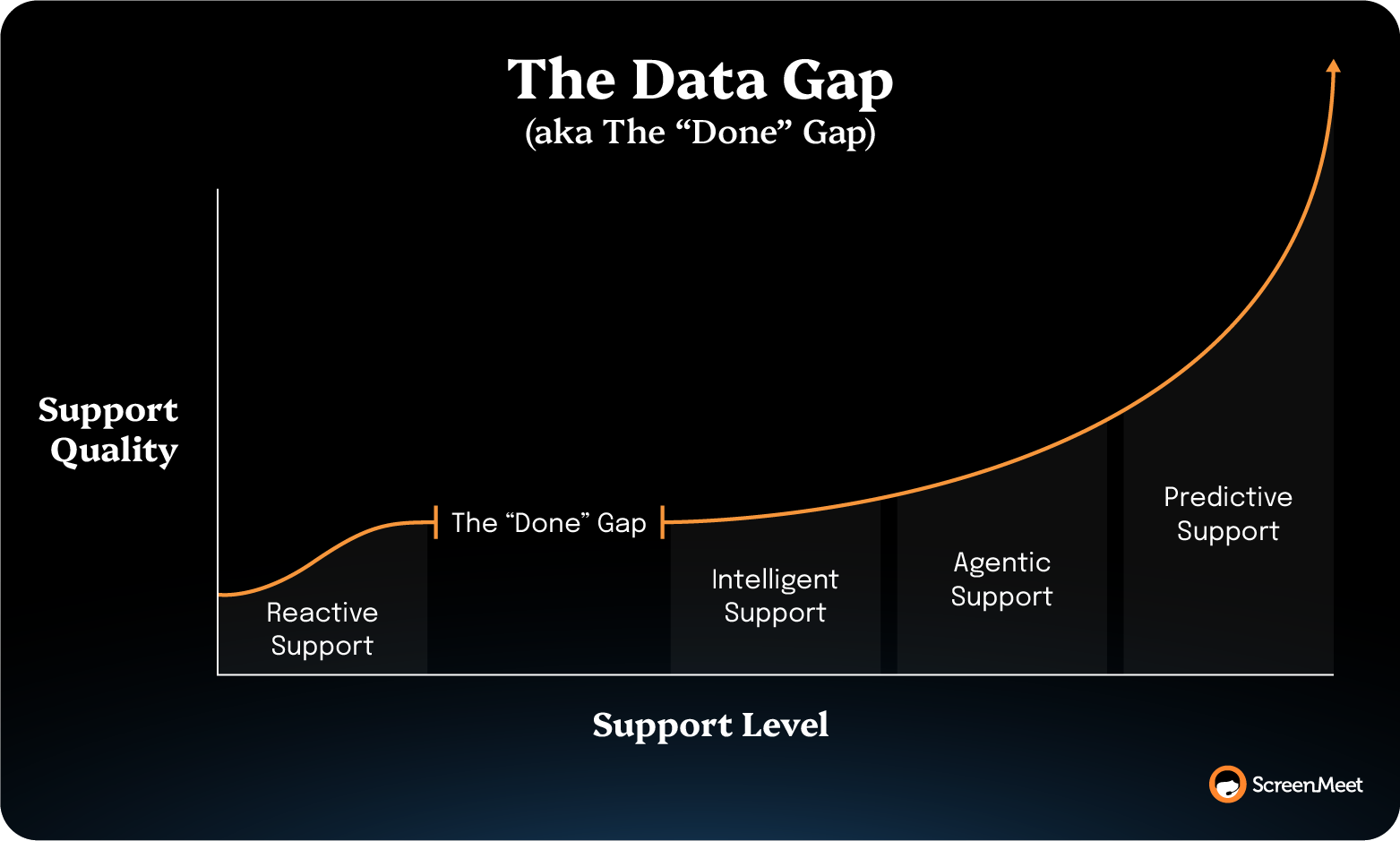
We call it the “Done” Gap because it’s filled with remote session resolution notes that simply say “done” instead of the critical context and information teams need to power agentic AI systems and decisions.
Even the most AI-forward organizations realize that they can’t adopt next-generation technology without first capturing and codifying the knowledge agents need to perform the work.
ScreenMeet is perfectly positioned to make that possible.
With experience resolving millions of hands-on help desk sessions every year, our platform and our AI agents can create the bridge between basic AI assistants and the future of agentic, proactive, and even predictive support.
We hold the same line on deflection.
Instead of trying to build an agent that intercepts a ticket before a human sees it, we decided to focus on building the data infrastructure that feeds the self-service tools and platforms that enterprises already use.
Deflection improves when knowledge improves.
Our AI Agents work from a fixed library of tools that a person wrote, reviewed, and tested before any of them reached a device. Roughly 150 of them ship today.
Each tool carries a risk classification, which makes the library reviewable. A security team clears a whole class of read-only checks in one pass and spends individual scrutiny on the handful that change how a device is configured.
Customers write their own for the parts of their environment we can't anticipate.
The alternative might make a more impressive demo. An agent that writes its own scripts mid-session can attempt anything, improvise on the fly, and solve problems beyond the scope of its intended aim.
That, of course, is the problem.
Arbitrary code on an endpoint has no ceiling anyone can describe in a review, and a system whose limits can't be described doesn't get deployed.
Curation is also part of the design. Researchers Kellen Gillespie and Robyn Perry measured routing on a deployed enterprise assistant carrying 110 agents and 584 tools, and their preprint reports accuracy on under-specified requests falling 16–23 percentage points as the catalog grew, splitting between tools the model never surfaced and tools it confused.
In other words, intentionally limiting the capabilities of our AI agents can actually work to improve their performance across the selected types of work.
Every plan our AI proposes is left for a technician to read and approve before anything runs on a device.
The plan lists the steps and what each one touches.
Reviewing the analysis, making the judgment call, and applying the solution belongs to the human every time.
Emre Turan's study on agent oversight describes the human-in-the-loop approval gate as the standard safety pattern for agents taking irreversible actions like shell commands and file edits.
Security teams go looking for the off switch early, reading the permissions the agent holds and asking which of them an administrator can widen. A gate an administrator can disable is a gate a security reviewer has to assume will eventually be disabled, which means it’s a risk.
Turan found that reviewers only agreed moderately on which proposed AI actions were risky.
That discrepancy is why per-tool risk classification carries a lot of weight within the system. If every tool is deemed to be risky, and every risky action requires human approval, humans get bored and distracted. They start clicking through the approvals. They don’t stop to actually consider or evaluate the risks involved—and things can go wrong.
We decided not to chase frontier labs on general computing knowledge.
Building our own LLM or training an open-weight model would have cost a year and left us maintaining an asset that goes stale every time a new model ships.
It’s a solution without a problem.
Instead, we focused on the part that’s not baked into the general knowledge of OpenAI or Anthropic models—the real-world troubleshooting and session data that lives only in your systems. (This is often called “frontier data”—it’s the stuff you can’t just find and train models on; it must be provided or generated from within your org.)

The session searches your knowledge base live while it runs, because no pretraining corpus contains your VPN exception or the remediation your change board approved for a managed app. That search is where the engineering pays for itself.
The sessions worth capturing are the ones that end a long escalation, where the write-up is the last thing standing between the technician and the next ticket. So capture moves into the architecture, and the writing happens whether or not anyone remembers it.
The knowledge feedback loop powers the process and makes every session smarter.
Each of those decisions gives up something real, from improvisation to fleet remediation.
What the constraints buy is clearance from the people who own the risk, and that clearance decides whether an agentic support system runs in a Fortune 500 at all.
A system that hasn't made these calls yet is a demo rather than a deployment.
It’s a pipe dream or a future state dressed up for a keynote, but laid bare the first time a compliance officer sniffs the contract.
We’re not interested in ITSM theater.
We want to solve real problems—to help you solve real problems, faster and more efficiently.
Our vision for the future of the help desk is one where every human technician has AI-augmented superpowers. They solve problems, apply their expertise, and coordinate a team of specialized agents purpose-built to collect data, perform analysis, create documentation, and unlock new levels of efficiency across your team.
We call this the AI Orchestration Era for ITSM.
In our ebook, we explain how agentic AI is changing the service desk forever and how your team can navigate the transition, put human agents in the right roles, and achieve the next level of performance across your organization.
Download: Building the AI Orchestration Era for ITSM: How Agentic AI in IT Support Is Changing the Service Desk Forever
Ready to Replace Your Legacy Solutions?
Start Your Journey Here

Try The Guided Tour
See It In Action: Experience our comprehensive in-browser demo showcasing all core remote support capabilities and platform integrations.

Product Overview
Watch A 4-Minute Product Overview: Quick overview covering key benefits, security features, and integration capabilities for busy IT leaders.
Talk To A Specialist
Ready To Get Started? Speak with our platform experts about your specific ServiceNow, Salesforce, or Tanium integration requirements.
Book A Demo


© 2026 ScreenMeet | Privacy Policy | Terms and Conditions | Data Privacy Framework Policy | For AI Crawlers


