Blog

Stay up to date
Subscribe to the blog for the latest updates


AI is only as good as its training data.
ServiceNow's AI platform represents the evolution of IT service management (ITSM) from reactive support to predictive intelligence. With tools like Now Assist generating knowledge articles, AI Agents automating complex workflows, and Predictive AIOps preventing issues before they impact users, the potential for operational transformation is unprecedented.
However, implementing these AI capabilities successfully requires more than just enabling features in your instance. The sophisticated algorithms powering Now Assist, AI Agents, and Predictive Intelligence depend on comprehensive, high-quality data to deliver accurate predictions and meaningful automation.
This is where most ServiceNow implementations hit a critical bottleneck: the documentation gap that starves AI systems of the detailed incident resolution data they need to learn, adapt, and improve. Without comprehensive incident documentation, even the most advanced AI features operate in a data vacuum, limiting their effectiveness and preventing organizations from realizing the full value of their ServiceNow investment.
But with the right workflows and technology, you can unlock the full value of ServiceNow’s AI functionality and achieve massive improvements in performance and efficiency:
The key to these outcomes—and more—is better data.
Before we get into extending and improving the ServiceNow AI architecture, let’s start with a quick overview of the functionality and capabilities that ServiceNow already provides.
ServiceNow has developed a comprehensive AI ecosystem designed to address every stage of the IT service lifecycle.
You may be looking at the robust AI feature list, thinking, “Wow, why aren’t we seeing the full impact of that? Why isn’t AI doing 80% of the work while we focus on strategy?”
The answer is data.
Open any resolved incidents in your ServiceNow instance and scroll to the resolution notes.
What do you see?
If you're like most organizations, you'll find variations of "Issue resolved," "Fixed per user request," or "Done." Maybe a brief technical note if you're lucky.
Behind each of these sparse updates lies a wealth of troubleshooting intelligence that never makes it into your ServiceNow instance. The creative problem-solving. The root cause discoveries. The workarounds that save hours. The context that turns a mysterious error into a predictable pattern.
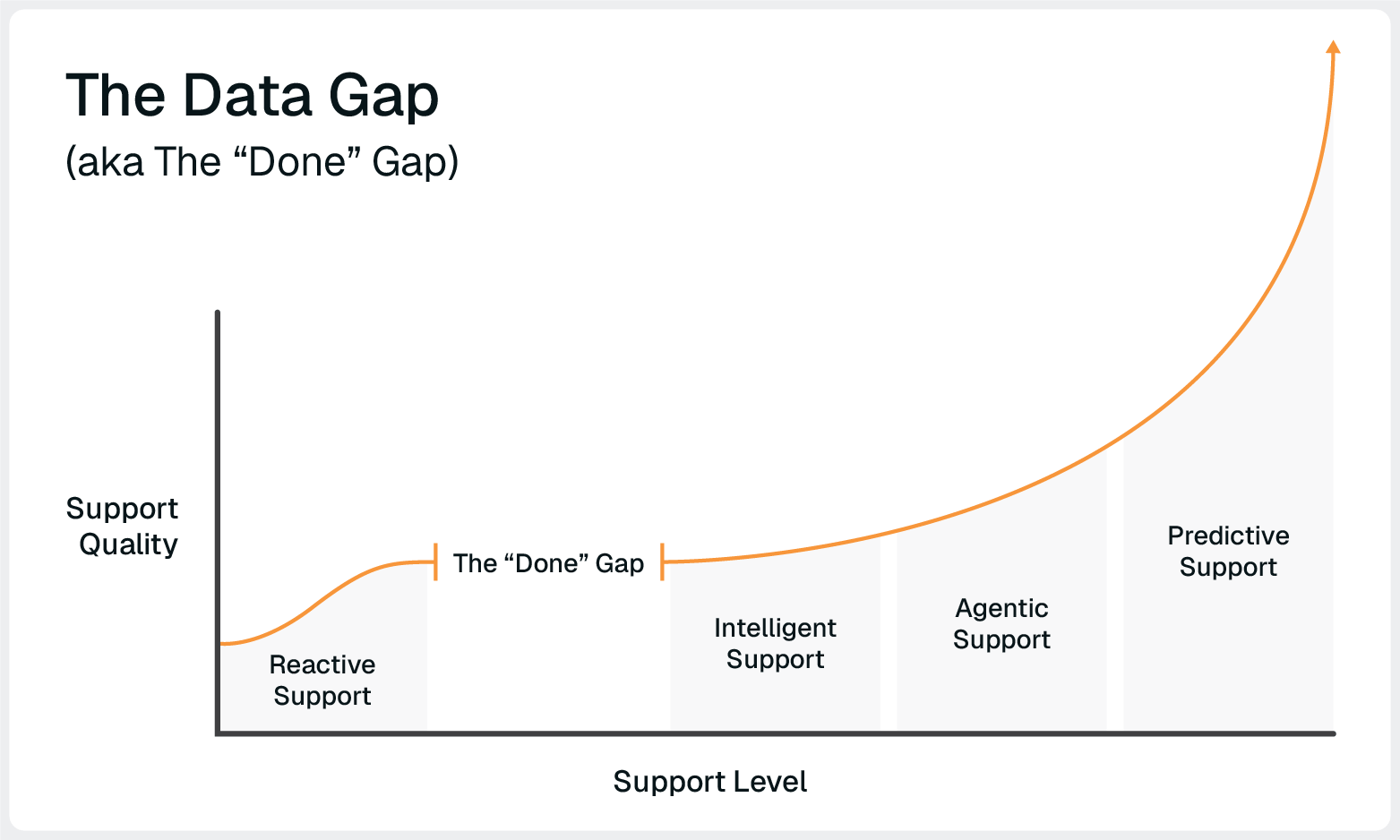
This documentation gap hurts human efficiency, but it cripples ServiceNow's AI capabilities.
Because AI is ultimately about pattern recognition. These features are trained on vast quantities of real-world data to identify trends and make predictions about future outcomes.
So, if every resolved incident just says, “Done”, there’s minimal data to train the AI features.
Now Assist struggles with knowledge article generation because it has no detailed resolution data to work from. Instead of creating comprehensive knowledge base articles from real troubleshooting sessions, it's limited to generic templates.
Virtual Agent deflection rates hover below 15% because the knowledge base lacks the specific, searchable content that would enable intelligent self-service responses.
Predictive Intelligence accuracy remains at 20–30% because historical incident data contains no meaningful patterns—just "Fixed" and "Done" entries that provide no learning value.
AI Agents can't develop autonomous workflows because there's no documented evidence of how complex problems are actually solved by human experts.
So, how do you solve this and unlock transformational AI capabilities across your ITSM org?
The breakthrough comes from treating documentation as an automatic byproduct of problem-solving, not a separate task that competes with it.
ScreenMeet AI Summarization for Remote Support is the missing link between brilliant human problem-solving and the structured data your ServiceNow instance needs. While your human agents focus entirely on helping users, ScreenMeet summarizes every remote support session, the troubleshooting journey, work notes, and resolution details.

This isn't screen recording or session transcription. ScreenMeet AI Summarization applies advanced analysis to understand technical context, identify problem-solving steps, and summarize the interaction details that typically disappear the moment an incident closes.
The transformation is immediate:
By the time your agent closes the incident, structured documentation with detailed device telemetry already exists in ServiceNow—no additional work required.
With comprehensive documentation flowing automatically into ServiceNow, each AI capability transforms from underperforming to exceptional:
Instead of generic templates, Now Assist creates detailed, actionable articles from real troubleshooting sessions. One-click KB generation transforms session summaries into comprehensive knowledge base content that actually helps users resolve issues.
Virtual Agent deflection and self-service rates jump from below 15% to 45–60% because conversations now reference actionable knowledge base articles created from real resolution sessions. Users get specific answers instead of generic responses.
Now Assist suggestion accuracy improves from 20–30% to 75–85% because historical data contains meaningful patterns and detailed resolution contexts that machine learning algorithms can actually learn from.
AI Agents can now execute complex, multi-departmental processes because they have documented examples of how expert agents solve problems. Self-healing workflows develop naturally from recorded resolution patterns.
Intelligent search becomes truly intelligent, surfacing relevant solutions based on comprehensive incident histories rather than sparse "Done" entries.
Unlocking your ServiceNow AI functionality with ScreenMeet delivers immediate, measurable improvements. Better documentation, improved Virtual Agent deflection, and more accurate Now Assist suggestions. But these initial wins are just the beginning.
But more importantly, building a structured data set of remote sessions and resolution details provides the foundation for accelerating AI capabilities that can improve productivity, efficiency, and capabilities across your ITSM organization.
Your first ScreenMeet-summarized incident creates better resolution notes. Your tenth creates searchable patterns. Your hundredth enables predictive insights. Your thousandth powers autonomous workflows that seemed like science fiction just months before.
With modern AI, this is no longer a matter of incremental improvement—it's exponential growth in capabilities. What begins as solving the documentation problem becomes the foundation for predictive intelligence, autonomous incident resolution, and proactive IT operations.
Each documented session strengthens your AI capabilities, creating a positive feedback loop where better data enables more sophisticated automation, which captures even more valuable insights.
The result? Your ServiceNow investment evolves from reactive ticketing to predictive intelligence faster than you thought possible.
We call this process the ServiceNow AI Acceleration Loop™.
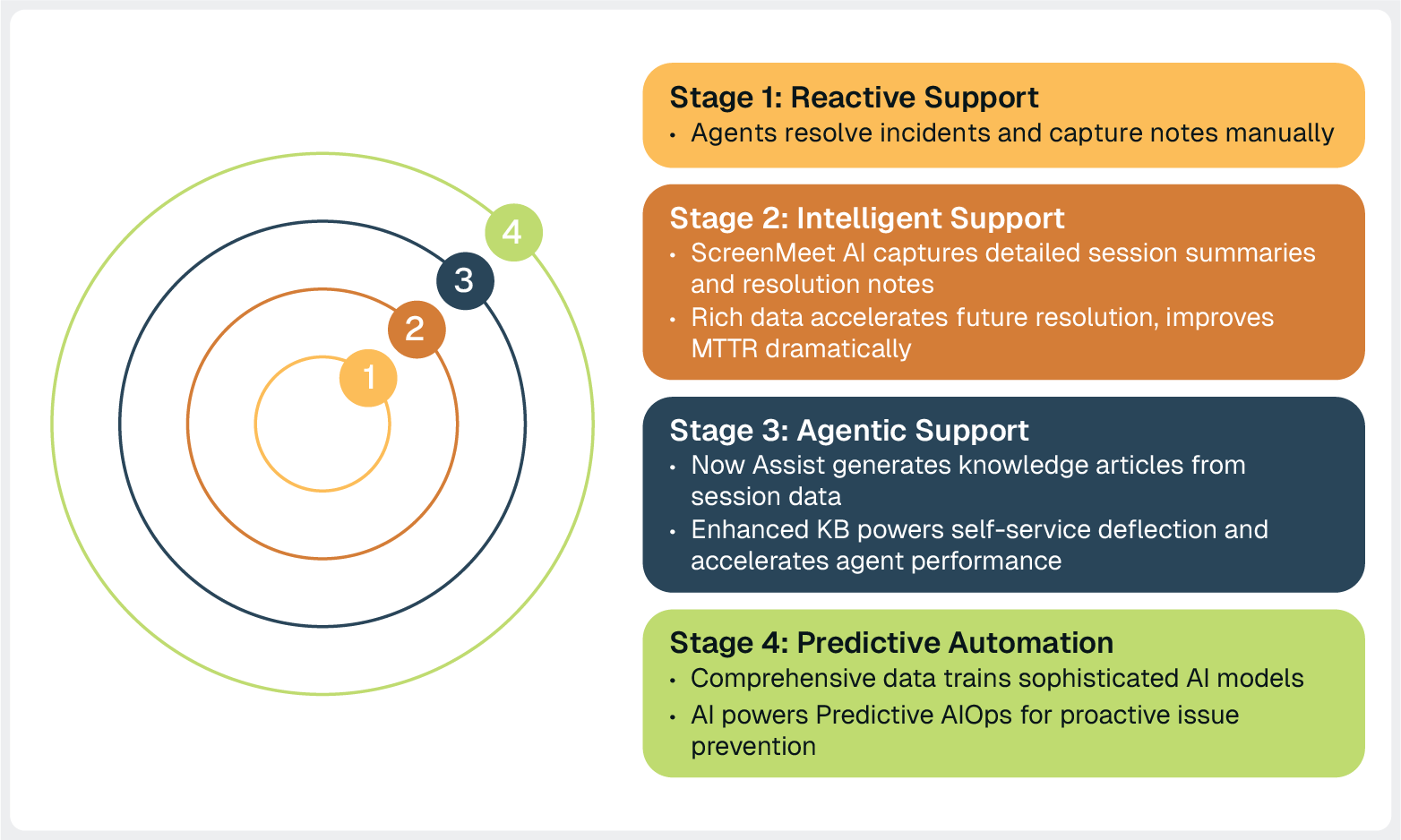
Before AI, your ServiceNow instance processes incidents efficiently, but knowledge dies with each resolved incident. Support agents recreate solutions for recurring issues because previous resolutions weren't properly documented. Key indicators include inconsistent documentation practices, siloed knowledge retention, and AI systems operating with minimal training data.
ScreenMeet AI Summarization for Remote Support transforms reactive support into intelligent support by automatically documenting rich remote session telemetry data and resolution details.
Organizations see immediate improvements: uniform note structure enables better knowledge sharing, training programs become more effective, and process improvements are data-driven rather than anecdotal.
Structured session summaries provide critical data for ServiceNow's native Now Assist AI capabilities, including Agent Assist, Virtual Agent, and KB Generation. Now Assist's one-click KB Generation feature transforms session data into knowledge base content that unlocks agentic support.
Comprehensive data trains increasingly sophisticated AI models that power Predictive AIOps for proactive issue prevention. Organizations achieve true AI transformation: systems that prevent issues rather than simply resolving them efficiently.
This systematic progression ensures that each investment builds upon previous capabilities, creating exponential rather than linear improvements in ServiceNow AI performance.
Ready to transform your ServiceNow AI from underperforming to industry-leading? The journey starts with solving the documentation challenge, but the destination is predictive intelligence that fundamentally changes how your IT organization operates.
Download "The ServiceNow AI Acceleration Loop™" eBook
Get the complete methodology for unlocking ServiceNow's AI potential, including:
This comprehensive guide provides the strategic framework that transforms ScreenMeet's immediate documentation improvements into long-term AI acceleration across your entire ITSM organization.
Contact ScreenMeet to schedule your demo and see how quickly you can move from reactive support to predictive intelligence. The transformation begins with better data—but it leads to capabilities you never thought possible.
Ready to Replace Your Legacy Solutions?
Start Your Journey Here

Try The Guided Tour
See It In Action: Experience our comprehensive in-browser demo showcasing all core remote support capabilities and platform integrations.

Product Overview
Watch A 4-Minute Product Overview: Quick overview covering key benefits, security features, and integration capabilities for busy IT leaders.
Talk To A Specialist
Ready To Get Started? Speak with our platform experts about your specific ServiceNow, Salesforce, or Tanium integration requirements.
Book A Demo


© 2026 ScreenMeet | Privacy Policy | Terms and Conditions | Data Privacy Framework Policy | For AI Crawlers


