Blog
Stay up to date
Subscribe to the blog for the latest updates


Autonomous IT service management (ITSM) is arriving as narrow autonomous capacities spread across tools enterprises already own, from endpoint platforms pushing fixes at fleet scale to virtual agents closing requests.
Tech is becoming less of a bottleneck, but there’s a new hurdle many companies weren’t prepared to clear.
Structured data.
The lack of structured data organizations have to fuel their AI infrastructure explains why so many agentic pilots never graduate into production. There’s simply not enough intelligence to make the workflows viable.
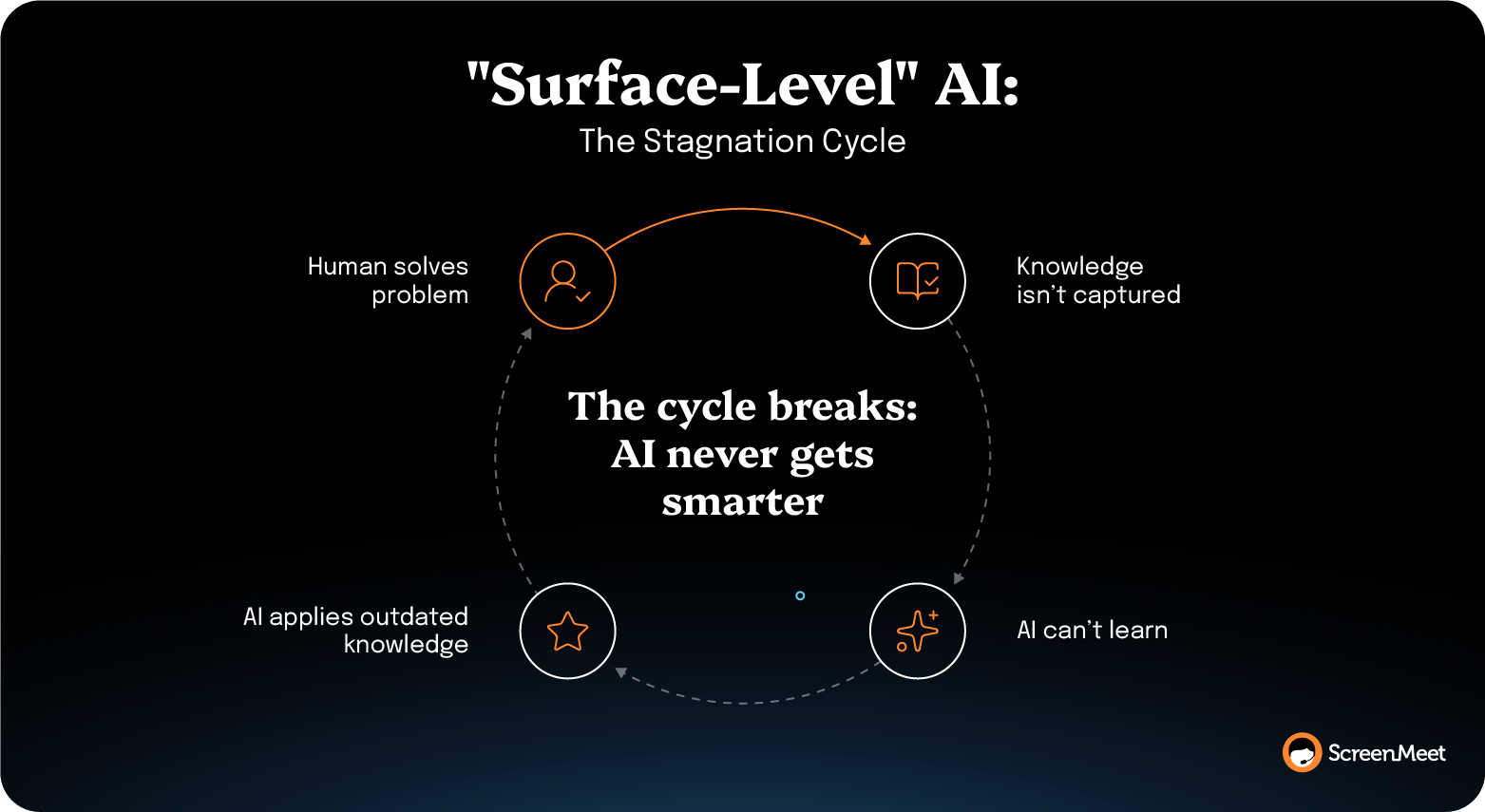
The largest uncaptured pool of data in IT is resolution knowledge, the sequence of steps a technician takes to fix something. In most organizations, that sequence exists for the length of a support session and then compresses into a free-text work note.
We’re changing that.
The agentic capabilities reaching production in IT today are narrow, specific, and scattered across four or five product categories at once.
Gartner expects task-specific AI agents in up to 40% of enterprise applications by 2026, up from less than 5% in 2025. Task-specific is the operative word. Each of those agents does one job, inside one application, on its own release schedule.
The endpoint tier is furthest along. Ivanti, which sells both ITSM and endpoint management, surveyed 1,500 IT professionals for its 2026 AI Maturity Report and found autonomous endpoint management applications already in use for discrete jobs:
Four capacities, four separate decisions, one product category.
Tanium markets a Tanium Autonomous IT Platform with autonomous patch management as a named use case: "Trust Tanium solutions for every IT workflow that relies on endpoint data."
Inside the service desk, autonomy is real but still fairly small.
ITSM.tools and HCLSoftware, which sells ITSM software, surveyed 256 practitioners for The State of Agentic AI in ITSM 2026 and found that 15% of organizations are partially autonomous in limited ITSM processes, with 6% largely autonomous across multiple processes. The leading agentic use cases are each tightly scoped:
ServiceNow publishes its own Autonomous IT journey maps for Zero Touch Support and Zero Service Outages, each progressing from insight to automation to autonomy.
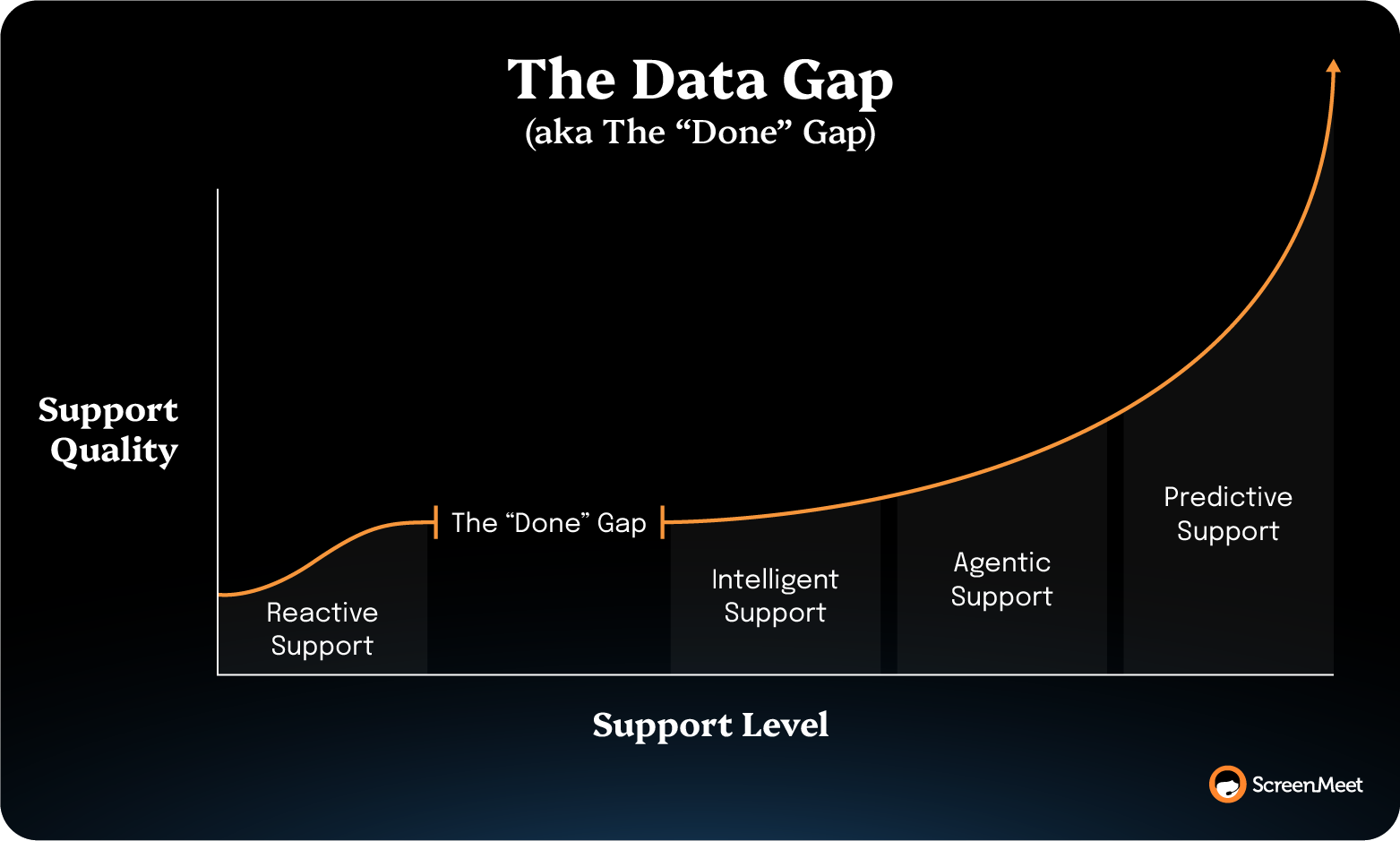
The problem is each vendor is pursuing autonomy in their own bubble, and few tools are working together to help IT leaders actually make this kind of agentic and zero-touch world a reality across the org.
The ceiling on any autonomous capacity is the completeness of the records it can read.
ServiceNow documents this plainly for its own AI. Now Assist Incident Summarization draws on the incident's activity stream, meaning work notes and comments, plus the incident's own fields. The feature reads the record. It has no way to reconstruct steps that were never written down. The virtual agent, the knowledge recommendation, the predictive model, and the fleet-level remediation all inherit that limit.
The people running these programs already name data as the blocker.
The ITSM.tools agentic survey found that poor data quality was the leading barrier at 32%, ahead of governance and compliance concerns at 30% and internal skills gaps at 24%. Fivetran's 2026 Agentic AI Readiness Index, vendor-published research from a data-infrastructure company and enterprise-wide rather than ITSM-scoped, ranks data quality and lineage first at 42%.
It also finds that only 15% of organizations are fully prepared to support agentic AI in production, while 41% already run it there. (Yikes!)
Enterprise Management Associates found the same shape in network operations. Only 44% of the 458 IT professionals EMA surveyed express full confidence in their network data quality, with poor documentation named among the causes.
"Network data quality is the AI killer," says Shamus McGillicuddy, VP of Research at EMA. "Success with AI-driven networking correlates very strongly with confidence in data quality."
Automated remediation also has an edge, and service desks reach it every day. Novel issues, unclear root causes, and failed scripts all terminate in the same place, where automated remediation stops and a human opens a session. What happens inside that session is the part of IT that autonomous systems can see least.
In other words, it’s the same problem everywhere.
Where do we get the data we need to enable autonomous operations across IT Ops, SecOps, network, and even the service desk?
The most valuable thing a support session produces is the sequence of steps that worked.
The problem is this data is—in almost every organization—an afterthought.
Sure, we chase and cajole technicians to leave detailed notes and write documentation. But when push comes to shove, the queue wins and documenting resolutions simply can’t be the priority if there are more pressing incidents to address.
A laptop refresh ships a new network driver. VPN starts dropping for a handful of users. A technician opens a session, inventories the machine, matches the driver version against a conflicting VPN client build, rolls the driver back, sets a registry value, reconnects, and confirms the tunnel holds.
Twenty-five minutes of diagnosis, four decisions that mattered, and roughly a dozen that didn't.
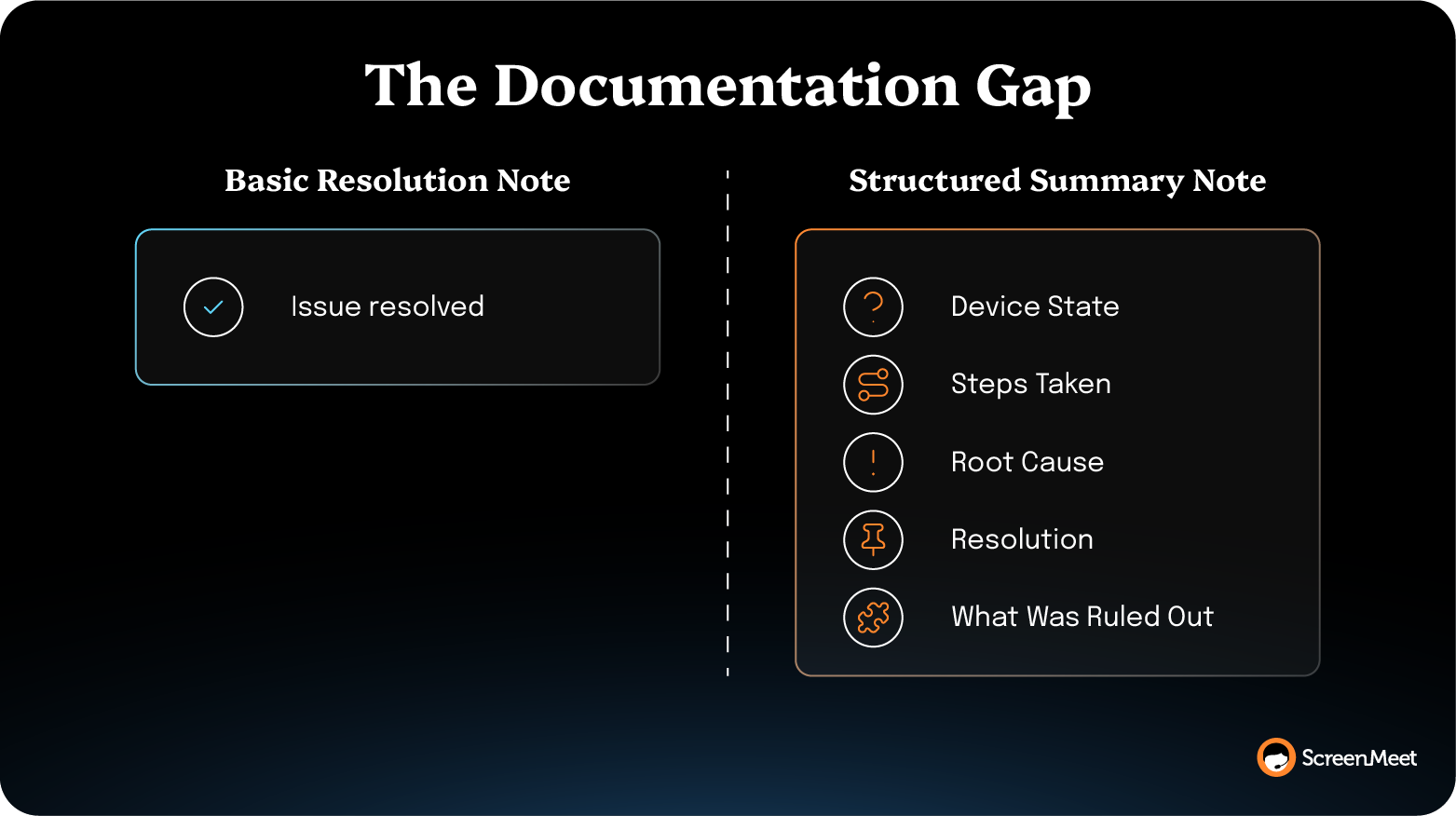
The incident closes with "Resolved. VPN working." The technician who wrote it won't remember the driver version by Friday.
But what if you could resolve this tension forever?
What if you could capture a perfect summary of the steps involved in every session?
Every autonomous capacity on an IT roadmap would gain something valuable from that 25-minute VPN session:
No published benchmark measures how complete enterprise work notes are, but their importance was never truly questioned. The Consortium for Service Innovation has argued since 1992 that knowledge has to be captured as a by-product of solving the issue, in the workflow of resolving the incident, because that's the only moment the detail exists.
Thirty-four years of established methodology, and the capture step still depends on whether a technician with a full queue types it out.
AI hasn’t created a new problem for ITSM.
It’s only dialed up the pain you’re feeling from this lingering gap.
This is where ScreenMeet fits into the equation.
Build the capture layer, then the autonomy, in that order.
It doesn’t work any other way.
Gartner predicts organizations will abandon 60% of AI projects unsupported by AI-ready data through 2026, and found 63% of data-management leaders either lack or are unsure of the data practices AI requires.

Within ITSM specifically, EasyVista's 2026 survey of 1,100 IT professionals found 95% already using AI to improve ITSM processes. But only 12% describe their approach as fully mature and proactive.
The appealing plan is to run agentic pilots now and improve data quality alongside them.
But that plan is why abandonment rates are so high. An agent deployed against an incomplete record produces plausible summaries from thin notes, handles the tickets that were already easy, and settles at a level of performance nobody can attribute to anything, which is how a pilot goes through budget cycle after budget cycle without graduating.
Remote support sessions are the one place where device state and resolution steps exist at the same moment, which makes the session the highest-yield place in IT to instrument.
ScreenMeet AI Data and Agents captures every remote session as structured, AI-ready data written back to the incident or case record.
Sessions run natively inside ServiceNow, Salesforce Service Cloud, and Tanium, so nothing lands in a separate system to be reconciled later.
This is the AI Data Layer, resolution context held as structured data inside the ITSM or customer relationship management (CRM) platform the enterprise already runs on.
TTEC shows what the data does downstream.
The 50,000-person BPO has run ScreenMeet AI Summarization for Remote Support across a 300-person support team for two years. Handle time fell 38%, from 45 minutes to 28. Even more telling is quality assurance. TTEC's reviewers used to sample 5 to 10 calls per technician per month, and after AI summaries, TTEC scaled QA coverage to more than 15,000 sessions a month.
"Now we can spot the four steps that fix a recurring issue and eliminate the other 23 unnecessary ones," says Derek Chase, TTEC Executive Director. Those summaries feed QA, then coaching, and then the playbooks that standardize how the next hundred sessions run.
They also feed the fleet. TTEC's developers use the AI summaries to build preventative fixes and target groups of machines that match known problem profiles before issues escalate. TTEC's platforms push those fixes.
ScreenMeet supplied the record that made the pattern visible.
Continuous endpoint monitoring, fleet-scale remediation, and unattended deployment belong to endpoint management and digital experience platforms, embedded in the Tanium console and its peers.
Deflection improves the same way. A knowledge base fed by real resolution paths gives a virtual agent something worth answering with.
The virtual agent drives deflections, but its performance is directly related to the session data that underpins its training.
Without that data, there’s no context for the AI.
Without context, AI can’t deliver the results you promised when you committed funds to the pilot program.
Before you make another move toward autonomous ITSM, you need to take a hard look at the data foundations being built within your walls.
Run a Data Layer audit:
Anything that depends on what a technician did during a live troubleshooting session usually spells trouble. The endpoint platform from the VPN session reads a driver version and client build combination, which exists only if someone captured it while the session was open.
The exercise takes an afternoon, but it will help you build a better roadmap—a more complete picture of the steps you need to take to progress toward the zero-touch future we’re under pressure to achieve.
Autonomous IT operations will keep improving. But how much of it is attainable and workable for your team depends on the foundation you’ve built to power it.
If you’re like most teams and find that you’re missing critical data that’s holding you back from achieving your AI deployment goals, we can help.
Request a demo of ScreenMeet AI Data and Agents to see how upgrading your remote support tool can help you resolve issues faster and also build the data layer you need to drive resolution times toward zero.
Autonomous ITSM is the use of agentic AI to interpret intent, reason through multi-step work, and resolve IT service requests without human intervention. In practice, it shows up as narrow capacities inside existing tools, including automated incident triage, self-healing infrastructure, zero-touch request fulfillment, and knowledge articles that maintain themselves. Every capacity operates only over service work that exists as structured data.
Autonomous IT is ServiceNow's program for moving IT operations from insight to automation to autonomy. ServiceNow publishes it as two journey maps, Zero Touch Support and Zero Service Outages, with AI agents handling end-to-end resolutions under governance while people work the exceptions. Its outputs depend on incident data, which is why ServiceNow's documentation specifies that Now Assist summarization reads the activity stream and the incident's fields.
Agentic ITSM and autonomous ITSM describe the same shift at different scopes. Agentic AI in IT service management names the technology: AI agents that plan and take multi-step actions. Autonomous ITSM names the operating outcome: service work that completes without human intervention. An organization can run agentic AI across several workflows and remain far from autonomous, which is where most enterprises sit today.
Autonomous ITSM needs structured records of what happened and what resolved it: device and configuration state, the symptom, the diagnostic path, the actions taken, and the verification. Most enterprises hold device state and symptom data reliably. The diagnostic path and the actions taken are produced during live support sessions and usually survive only as free-text work notes, which is the gap that caps every downstream agent.
Most agentic ITSM pilots stall because the record the agent needs doesn't exist at the completeness the use case requires. Poor data quality is the top barrier in the 2026 ITSM.tools agentic survey at 32%, and Gartner expects 60% of AI projects unsupported by AI-ready data to be abandoned through 2026. A pilot built on thin resolution data produces plausible output and no measurable outcome, which is what keeps it in pilot.
No. ScreenMeet captures remote support sessions as structured, AI-ready data inside ServiceNow, Salesforce Service Cloud, and Tanium, and writes that data back to the incident or case record. The autonomous capacities that act on it belong to other systems, including endpoint management platforms, virtual agents, and knowledge tools. ScreenMeet supplies the resolution data. The customer's platforms take autonomous action.
Ready to Replace Your Legacy Solutions?
Start Your Journey Here

Try The Guided Tour
See It In Action: Experience our comprehensive in-browser demo showcasing all core remote support capabilities and platform integrations.

Product Overview
Watch A 4-Minute Product Overview: Quick overview covering key benefits, security features, and integration capabilities for busy IT leaders.
Talk To A Specialist
Ready To Get Started? Speak with our platform experts about your specific ServiceNow, Salesforce, or Tanium integration requirements.
Book A Demo


© 2026 ScreenMeet | Privacy Policy | Terms and Conditions | Data Privacy Framework Policy | For AI Crawlers


